Institute of Microbiology Successfully Hosts Symposium on AIDS Research in the 21st Century: Challenges and Opportunities
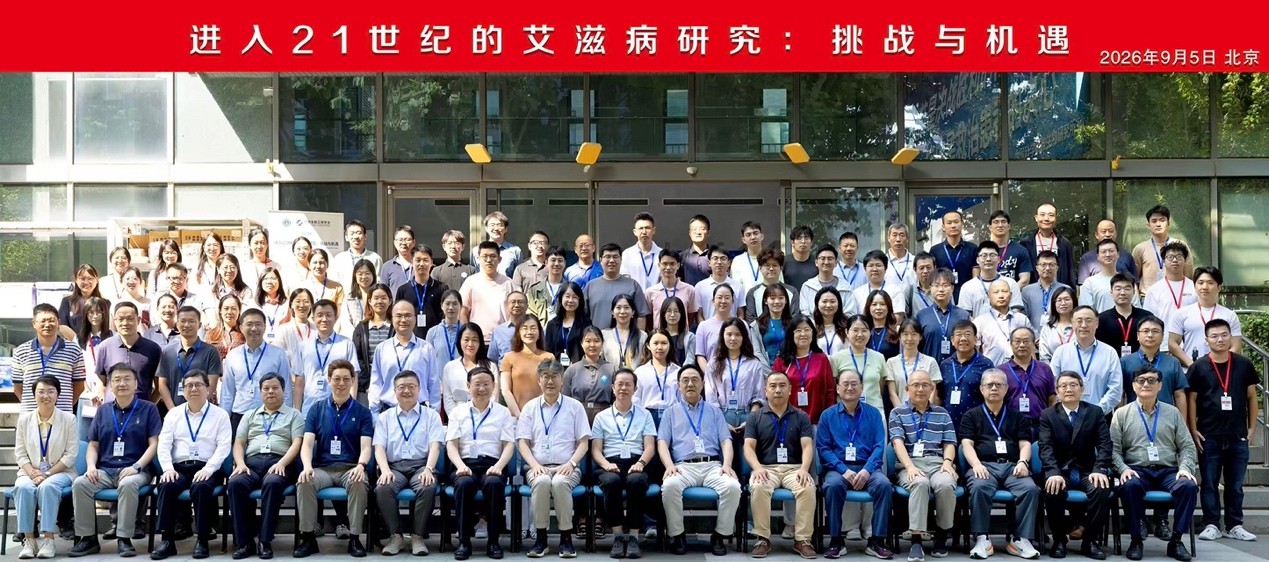
On September 5, 2026, the symposium “AIDS Research in the 21st Century: Challenges and Opportunities” was successfully held at the Institute of Microbiology, Chinese Academy of Sciences. The symposium was hosted by the Institute of Microbiology, Chinese Academy of Sciences and the Chinese Society of Biotechnology, and co-organized by the journal hLife. Wei Qian, Director of the Institute of Microbiology, Chinese Academy of Sciences, attended the opening ceremony and delivered remarks, and Academicians George F. Gao and Fusheng Wang of the Chinese Academy of Sciences gave invited lectures. Experts and scholars in HIV/AIDS basic research, vaccine development, clinical diagnosis and treatment, and public health prevention and control from across China gathered to focus on the frontiers of basic and clinical HIV/AIDS research, to explore new pathways for prevention, treatment, and cure, and to hold in-depth discussions on the challenges and opportunities in HIV/AIDS research.
The opening ceremony was chaired by Professors Haitao Hu and Feng Gao, the chairs of the symposium. On behalf of the host institutions, Director Qian extended a warm welcome and sincere thanks to the attending experts and scholars. He noted that HIV/AIDS prevention and control is a major global public health issue, and that since the beginning of the 21st century, new challenges and breakthrough opportunities have continued to emerge in fields such as viral mutation, long-acting prevention, cure research, clinical diagnosis and treatment, and the development of biologics. The symposium was intended to build a high-level platform for exchange spanning basic medical science, virology, biotechnology, and clinical prevention and control in the field of HIV/AIDS, to systematically review frontier advances in the field, and to discuss in depth the existing bottlenecks and innovative solutions. Director Qian emphasized that the Institute of Microbiology, Chinese Academy of Sciences, has long been deeply engaged in basic research in virology and immunology, and he expressed the hope that the symposium would serve as an opportunity to further pool the wisdom of peers across the country, promote the deep integration of basic research with clinical diagnosis and treatment and public health prevention and control, and make greater contributions to strengthening China’s capacity for HIV/AIDS prevention and control and to safeguarding people’s lives and health.
During the invited lecture session, Academician Gao, drawing on his long-standing academic work in pathogen microbiology and immunology, shared his in-depth reflections on HIV/AIDS research in the 21st century. He pointed out that over the past two decades, HIV/AIDS research and prevention and control have made tremendous progress: antiretroviral therapy has gradually turned HIV/AIDS from a fatal disease into a chronic condition that can be managed over the long term, and strategies such as testing, pre-exposure prophylaxis, and treatment as prevention have continued to expand the boundaries of comprehensive prevention and control. However, bringing the virus under control does not mean that the problem is fully solved; issues such as the viral reservoir, poor immune reconstitution, resistance during long-term treatment, and aging-related comorbidities persist, and public health challenges, including early detection, prevention and control among key populations, the accessibility of interventions, and social discrimination, cannot be overlooked. Academician Gao emphasized that new technologies such as long-acting drugs, broadly neutralizing antibodies, therapeutic vaccines, and gene and cell therapies are creating new opportunities for the long-term control and even functional cure of HIV/AIDS, and that the future urgently requires deep collaboration among basic research, clinical research, and public health efforts. Academician Wang delivered a plenary invited lecture on the latest advances in clinical HIV/AIDS research, diagnosis, and treatment, sharing forward-looking academic insights.
The symposium featured three academic sessions: “HIV/AIDS Vaccines,” “HIV/AIDS Cure,” and “Basic Science, Treatment, and Models.” Experts and scholars from Chinese universities, research institutes, and clinical institutions delivered 14 special reports in total, systematically presenting the full-chain progress of China’s HIV/AIDS research, from basic mechanisms to clinical translation and from vaccine development to cure exploration. In the “HIV/AIDS Vaccines” session, experts including Feng Gao, Yiming Shao, Zhiwei Chen, Ling Chen, and Haitao Hu gave special reports on the advantages and opportunities of China’s HIV/AIDS vaccine research, the design and clinical trials of replication-competent vector HIV vaccines, long-acting HIV-1 broadly reactive tandem bispecific neutralizing antibodies, the induction of mucosal sIgA antibodies, and the application of mRNA technology in HIV/AIDS vaccine and cure strategies. In the “HIV/AIDS Cure” session, experts including Hui Zhang, Shuwen Liu, Jianqing Xu, Liang Shan, and Kai Deng gave special reports on immunotherapy for HIV-1 functional cure, HIV latency host factors and targeted cure drugs, functional cure of HIV/AIDS from bench to bedside, the application of inflammasomes in HIV/AIDS cure, and the impact of CD4+ T cell–HIV-1 interactions on the viral latent reservoir. In the “Basic Science, Treatment, and Models” session, experts including Xiaofang Yu, Xi Zhou, Yuxian He, and Yongtang Zheng gave special reports on NSG-mediated mechanisms of HIV restriction, basic models of viral diseases based on virus–host interactions, advances in the development of peptide drugs targeting viral membrane fusion, and research on non-human primate and animal models of HIV/AIDS.
That afternoon, Academician Gao chaired a roundtable discussion on the theme “Challenges and Opportunities in Basic and Clinical HIV/AIDS Research,” joined by Taisheng Li, Mengjie Han, and Hongzhou Lu. The attending experts held an in-depth dialogue on the core challenges currently facing HIV/AIDS research and prevention and control, the weak links in public health prevention and control, the mechanisms of poor immune reconstitution and chronic immune activation, viral reservoirs and obstacles to functional cure, real clinical needs, the clinical translatability of new technologies, the development of cohort and sample bank platforms, the redefinition of criteria for treatment success, precise and sustainable models of comprehensive prevention and control, and a basic–clinical–prevention collaborative system. They confronted the practical difficulties in the prevention and control chain while also looking ahead to the directions for breakthroughs over the next five to ten years. In his closing summary, Academician Gao noted that HIV/AIDS research has developed to the point where no single discipline or technology can solve the problem alone: basic research determines how far we can go, clinical problems determine where research should be directed, and public health determines how many people can benefit from scientific progress. The attending experts agreed that future breakthroughs require both a deeper understanding of the virus and host immune mechanisms and high-quality clinical research and long-term cohort support, and that they require more effective and safer tools for treatment and prevention as well as genuine accessibility, affordability, and acceptance of these tools by the target populations.
This symposium brought together the core strength of China’s HIV/AIDS research community. Through invited lectures, special reports, and roundtable discussions, it systematically reviewed the frontier advances in HIV/AIDS research and prevention and control, discussed in depth the existing bottlenecks and innovative solutions, offered important inspiration to young researchers, and built a high-level platform for advancing deep cooperation among China’s basic, clinical, and public health forces in HIV/AIDS and for jointly exploring new pathways in prevention, treatment, and cure research.
附件:
