Academician Gao Fu's team unveils the cross-species transmission mechanism of H5N1 avian influenza virus spread by cattle.
Recently, a research team led by Academician Gao Fu conducted an in-depth study on the receptor-binding characteristics, tissue tropism, and structural changes of the hemagglutinin (HA) protein of the H5N1 avian influenza virus transmitted by cattle. The findings elucidate the molecular basis of the HA protein's receptor preference and highlight the potential epidemic risk of the virus, as well as the urgent need for continuous monitoring of this emerging pathogen. The research results were published in a paper titled "Receptor Binding, Structure, and Tissue Tropism of Cattle-Infecting H5N1 Avian Influenza Virus Hemagglutinin" in the top international journal Cell on January 22, 2025.
Since 2024, the highly pathogenic H5N1 avian influenza virus (clade 2.3.4.4b) has been spreading persistently among cattle in the United States and causing human infections, attracting global attention. Infected dairy cows often exhibit symptoms such as reduced appetite, changes in fecal consistency, rapid breathing, and decreased milk production. Infectious viruses and viral RNA have also been consistently detected in cow milk. In April 2024, a dairy farm worker in Texas was diagnosed with H5N1 virus infection after contact with infected cows, marking the first reported case of cow-to-human transmission. The patient's primary symptom was conjunctivitis. As of January 17, 2025, 67 cases of highly pathogenic H5N1 virus infection have been confirmed in the United States, most of which were associated with contact with dairy cows. Why does the virus exist in large quantities in milk? Why does it cause conjunctivitis in humans? Has the virus gained the ability to spread among humans? These questions urgently need answers.
Focusing on the first H5N1 strain (A/Texas/37/2024) of bovine origin that infected humans, researchers first used surface plasmon resonance (SPR) experiments to detect the HA protein encoded by the virus. The results showed that the bovine H5N1 virus HA preferentially binds to avian α2-3 sialic acid receptors but also has a weak ability to bind to human α2-6 sialic acid receptors. Subsequent immunohistochemical staining revealed that this H5N1 HA protein strongly binds to bovine lung and mammary tissues, consistent with clinical symptoms. In contrast, the HA proteins of common human seasonal influenza viruses (H1N1 and H3N2) could not effectively bind to the corresponding tissues in cattle. Additionally, the bovine H5N1 HA protein significantly binds to human conjunctival, tracheal, lung, and mammary tissues, whereas the HA proteins of H1N1 and H3N2 viruses only significantly bind to human tracheal tissues. This finding provides a strong explanation for the molecular mechanism of bovine H5N1 virus-induced conjunctivitis in humans and reveals its distinct tissue tropism compared to seasonal influenza viruses.
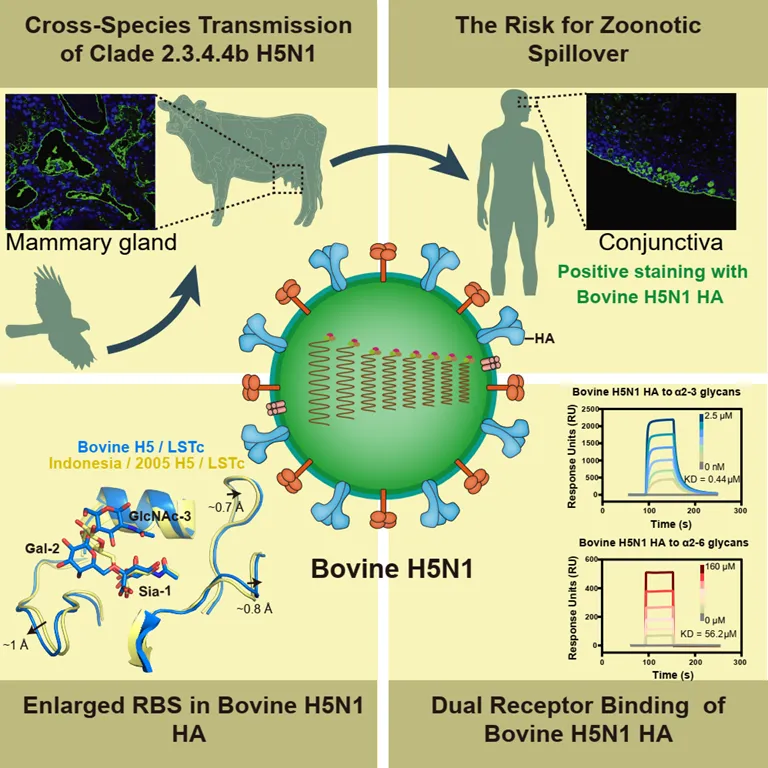
Figure 1. The cross-species transmission mechanism of H5N1 avian influenza virus spread by cattle.
The research team further utilized high-resolution cryo-electron microscopy (cryo-EM) to resolve the complex structures of the virus's HA protein with avian α2-3 and human α2-6 sialic acid receptors. They discovered that its receptor-binding site (RBS) is wider than that of previous H5N1 strains, enabling more effective binding to both receptors and exhibiting dual-receptor binding characteristics. These findings elucidate the molecular mechanism of the bovine-origin H5N1 virus in cross-host transmission at the molecular level and underscore the importance of continuous monitoring and in-depth research on this emerging pathogen.
The co-first authors of the paper include Song Hao, a researcher at Beijing Ditan Hospital, Capital Medical University/Beijing Institute of Infectious Diseases; Hao Tianjiao, a postdoctoral fellow at the Beijing Institute of Life Sciences; Han Pu, a postdoctoral fellow at the Institute of Microbiology, Chinese Academy of Sciences; Wang Haichen, a master's student at Hebei University; and Dr. Zhang Xu from Beijing Tongren Hospital, Capital Medical University/Beijing Institute of Ophthalmology. The corresponding authors are Academician Gao Fu from the Institute of Microbiology, Chinese Academy of Sciences; Professor Wang Ningli, Director of Beijing Tongren Hospital/Beijing Institute of Ophthalmology and Henan Academy of Medical Sciences; Dr. Sun Lei, Director of the Pathology Department at Beijing Ditan Hospital; and Researcher Song Hao. The study received strong support from Dr. Jin Ronghua, President of Beijing Ditan Hospital; Dr. Chen Jiamin; Researcher Bi Yuhai and Associate Researcher Zhang Wei from the Institute of Microbiology, Chinese Academy of Sciences. The research was funded by the National Natural Science Foundation of China.
The Gao Fu team has long been dedicated to the surveillance, tracing, and cross-species transmission mechanisms of avian influenza. They have revealed the molecular mechanisms of cross-species transmission for highly pathogenic H5N1 avian influenza virus, human-infecting H7N9, H10N8, H6N1, and H3N8 viruses, and conducted systematic research on potentially high-risk influenza viruses such as type D influenza virus, bat-origin H17N10, and H4 subtypes. Their work has made significant contributions to the study of viral structural foundations and transmission patterns. Their research achievements have been selected multiple times for the "Top Ten Scientific Advances in China" and have earned honors such as the First Prize of the National Science and Technology Progress Award, the Special Prize, and the First Prize of the Chinese Preventive Medicine Association Science and Technology Award.
Related paper information: https://doi.org/10.1016/j.cell.2025.01.019
DOWNLOAD: